Part of Temporal Constructs Appendix, which contains details behind the research: dates, quotations, descriptions of instruments, and sources.
General definition
Vangelis was a Greek composer and performer, born Evangelos Odysseas Papathanassiou, who lived from 1943 to 2022. He worked almost exclusively with electronic instruments and was one of the figures who established instrumental electronic music from the 1970s onwards. His album Direct of 1988 marks his move to digital from analogue equipment and his method of composing, arranging and recording in a single pass without pre-programming or overdubs.
Relation to the practice
Vangelis is a case in the research of a performer for whom spontaneity and creative momentum are the priority. He lost both in his transition to digital instruments and resolved the problem with a system built to his own requirements. The problem is the one this practice works on. The intelligent instruments of the MIDI era took his position that a synthesiser is a performance instrument, and later music software abandoned it.
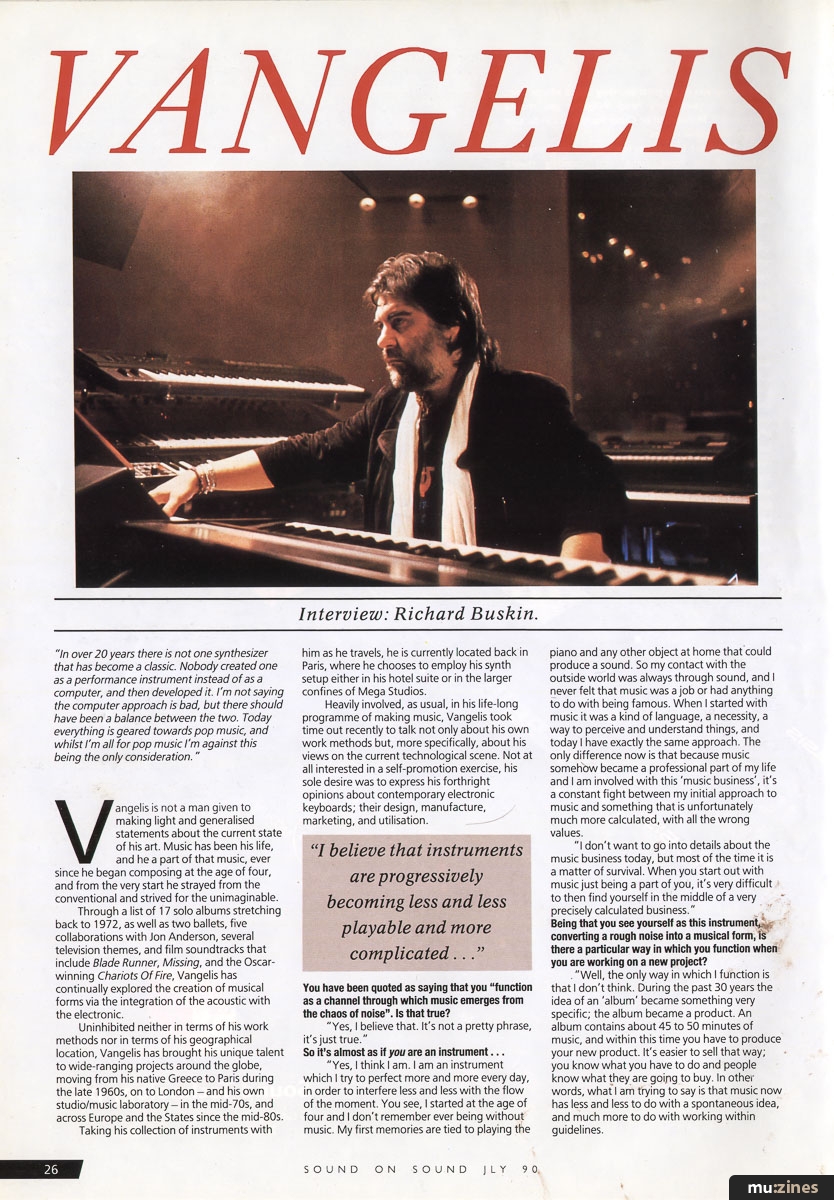
Vangelis, an interview by Richard Buskin in Sound On Sound, July 1990, page 28. Read the article on mu:zines. Held as research material, credited to the magazine and to mu:zines.
Recording of Direct
Direct was recorded in 1987 at Sound Studios in Athens and released in September 1988. It was the first album he made in Athens after he moved his base there from London. Its sleeve notes describe a method in which composing and recording happen at once, in a single act of playing. Custom MIDI performance systems built for him made this possible, along with the Zyklus MIDI Performance System developed by the technicians Bill Marshall and Pete Kellock.
The title is also reported as the name of the performance system built for him as the successor to the Zyklus. The album notes a change of equipment and the refusal of the workflow that usually comes with it. Vangelis stated later that he wanted to perform what came into his head and heart without delay. He described programming track by track on computers as a nightmare.
Relation to the masterclass
The masterclass In Conversation with Your Instrument used two clips of Vangelis. In one clip he objected to what digital instruments had done to playing. In the other he played the system he had built to answer it. The masterclass makes the same argument about constraints, memory and performance.
Much of the research on this period comes from Muzines, where the interview he gave Sound On Sound in July 1990 appears. There his judgement on two decades of instruments is noted. None had become a classic, and nobody had built a synthesiser as a performance instrument and then developed it. A balance between the two approaches had been lost.