Part of Temporal Constructs Main Text, which states the research questions, the proposals, the work done and what is still open.
General definition
A 16-bit personal computer from Atari, introduced in 1985, with built-in MIDI ports that made it a common computer for music.
Relation to the practice
An Atari ST runs Trip-A-Tron in ALTERITY, supplied by MiSTer reconstructions of the machine. The practice also emulates the machine for work on KML, because the original timing conditions matter for MIDI.
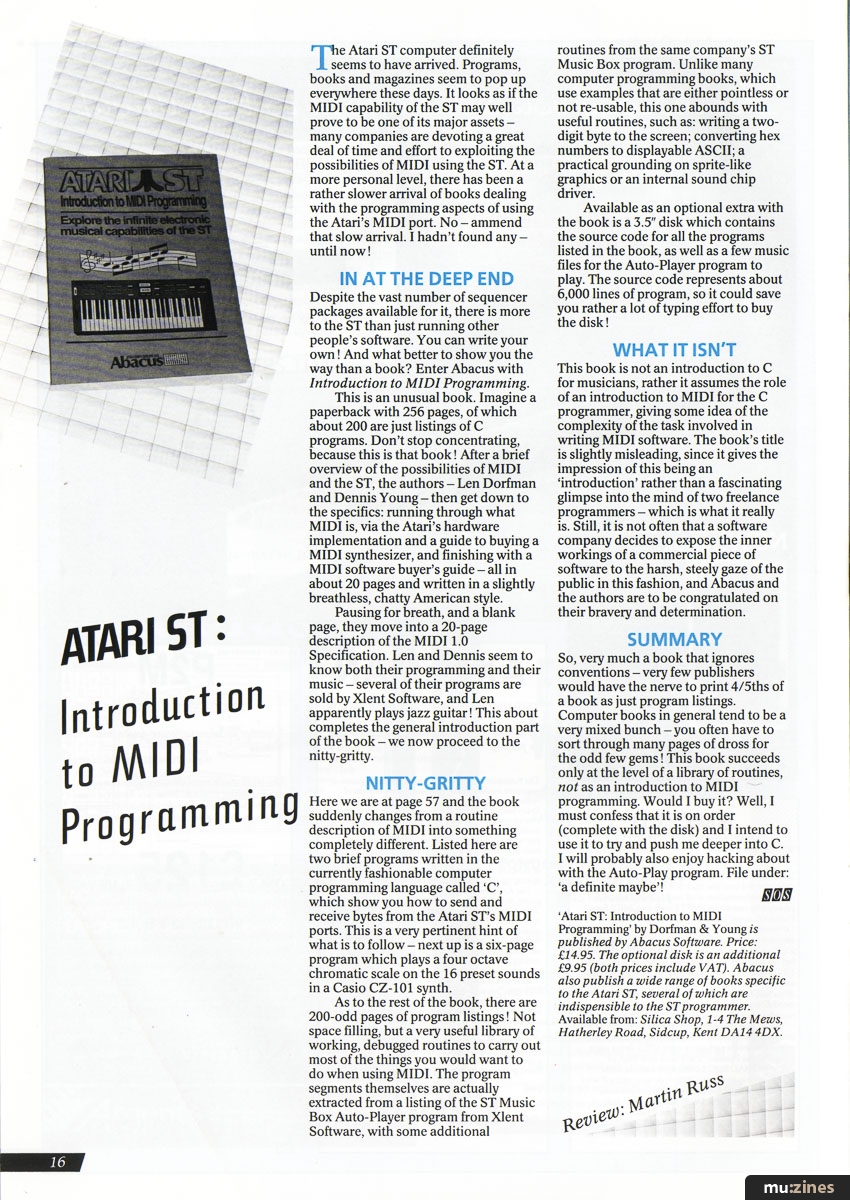
MIDI on the Atari ST, Sound On Sound, September 1987, page 18. Read the article on mu:zines. Held as research material, credited to the magazine and to mu:zines.
An original stands in the installation, not running. The original is shown to the audience at the points in the narration where the machine is the subject.
Screen and control
The Atari ST is driven by Hermes Agent with custom optical character recognition (OCR) tools that read what is on screen. Trip-A-Tron has no draggable windows, so each screen can be mapped in advance. That mapping makes computer use reliable and reduces the need for interpretation.
Unforeseen
Here the unforeseen situations, sometimes difficult, sometimes unexpectedly interesting, will be described as the project runs. Many of these unforeseen situations have already occurred and have been recorded. They will be added in the time to come.