Part of Temporal Constructs Main Text, which states the research questions, the proposals, the work done and what is still open.
General definition
Hierarchical Music Specification Language is a Forth-based language for composition and interactive performance. David Rosenboom began the work as software for the Buchla Touché, with Foil, the Far Out Instrument Language, as that machine’s user software; that first version of 1979, released in April 1980, is the precursor of HMSL rather than the language itself. HMSL dates from 1985, when Rosenboom, Larry Polansky and Phil Burk developed it at Mills College, and it later ran on the Amiga and the Macintosh.
Relation to the practice
HMSL is the clearest case of the doctorate’s claim that small languages encode a refined model of how composition works. A JUCE-based implementation has been ported to headless Linux so that agents can program it. In RETRIEVAL HMSL may drive a Yamaha FB-01 as its sound engine. A planned mapping onto KML would make it a visual composition tool as well.
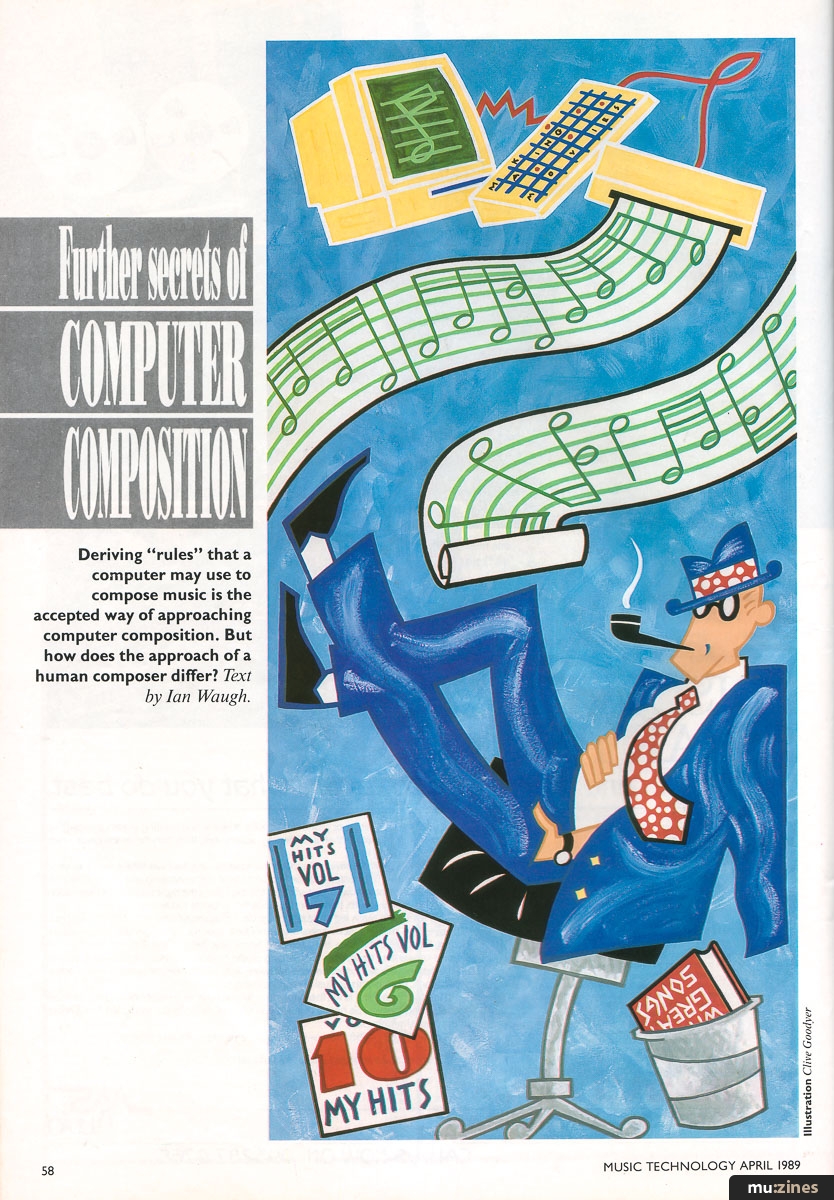
Further Secrets Of Computer Composition, a feature series that names HMSL, Music Technology, April 1989, page 60. Read the article on mu:zines. Held as research material, credited to the magazine and to mu:zines.
Port
Bringing the language back to use was one of the plan’s technical contributions, and it was carried through in April 2026 with the help of an agent. The doctorate agreed a design in which a language model writes HMSL code, Max saves it to a fixed file, and a MIDI message makes the language run it. The Macintosh port gained MIDI input, and the cross-platform port was brought up, both within a week. The Linux build stopped on its MIDI set-up, which called routines that exist only on the Amiga, a dependency the language inherits from its history. The doctorate approached Phil Burk, the author of the language, in the same month.
By May 2026 the failures had accumulated into a picture of unrelated faults. A single bit-shift error in the C layer explained them, because every call from Forth arrived with no arguments at all. With that found, the port reached full completion at the Forth level, exiting cleanly from a single voice. The doctorate verified output on MIDI, and the scheduler worked.
The doctorate wrote two reference documents beside it, one on the architecture and one on the boundary between C and Forth. The doctorate set a rule that compositions stay fully cross-platform, so that everything a platform needs stays in the platform layer. A four-channel composition in the style of Burk’s XForms was the first thing the port carried.
Architecture compared
In October 2026 the doctorate explained the language’s object hierarchy in the terms of a studio. The hierarchy holds shapes, players, instruments and collections. The artist corrected a first description that had Trip-A-Tron in the wrong place.
Setting the language beside CONDUCTOR produced a negative result. The system’s isolated, real-time modules cannot be rebuilt inside the language’s single cooperative loop, but its mapping of controllers and its way of storing snapshots fit. The language’s postfix notation resembles the way a language model produces text one step after another, and the comparison is an analogy rather than a claim of a shared mechanism.
Origins of HMSL
Rosenboom wrote the first version for the Buchla Touché, one of the early digital sound-generation instruments. He began it in 1979 and released it in April 1980, with Foil, the Far Out Instrument Language, as the machine’s user software. That version is the precursor of HMSL, and the language itself dates from 1985 at Mills College. Since the 1960s his aim had been to incorporate compositional procedures into the structure of instruments themselves.
He first worked with analogue computers in live performance. The Touché gave that ambition a digital home. He developed a formal model for the next generation with Polansky from 1980, while both were at the Center for Contemporary Music at Mills College.
Design of the language
The language rests on a hierarchy built for the Touché. Elements are the lowest-level items. Collections group them by rules of membership, and ordered collections keep an order. Shapes are the contours that much of the compositional work manipulates.
Generators output the data that is materialised in sound. Probabilistic processes came with Burk’s involvement, in which connections between modules carry weights or tendencies, and one module tends to stimulate the next. Its authors set out to make the language style-agnostic, and they regarded it as a tool and as an artwork.
Forth, Amiga and Macintosh
Burk joined in 1984 on an Inter-University Consortium on Educational Computing grant, and he took the largest share of the coding. The language settled on Forth, which runs well on small machines. The developers preferred the Amiga, because it used the same Motorola processor the Macintosh would use, at lower cost. Once the Macintosh came to dominate the market, Burk made the language run there.
Frog Peak community
The language was sold through Frog Peak Music, a composers’ publishing collective founded by Polansky and Jody Diamond. It was sold on three-inch discs at a small price. A community of users grew around it, and it lasted ten to fifteen years. Continually changing computer architectures then made the language difficult to maintain.
Composition by agents
Agents have used HMSL and composed music in it. The doctorate presented that work publicly for the first time at Human After All? in Rotterdam on 1 May 2026. The port the agents worked in had no MIDI input of its own, which limited the work and kept the interaction shallow. A system that cannot be played in real time can only be programmed. The wider history is larger than the language itself, because HMSL compositions and their code have been preserved. That preservation makes the language usable as research material and as a document.
Unforeseen
Here the unforeseen situations, sometimes difficult, sometimes unexpectedly interesting, will be described as the project runs. Many of these unforeseen situations have already occurred and have been recorded. They will be added in the time to come.