Part of Temporal Constructs Appendix, which contains details behind the research: dates, quotations, descriptions of instruments, and sources.
General definition
An effects processing module made by Lexicon, released in 1989, with pitch shifting, delay and reverb, and presets that are selected and changed over MIDI. Its manual covers rigs of one or more LXP-1 and LXP-5 units.
Relation to the practice
Two LXP-5 units run together are among the eight stations of CONDUCTOR, and they build the spatial field across the four channels of ALTERITY. The module carries the effects rather than a sound of its own, so nothing it does is heard except through the Kurzweil K2000 that feeds the four corners.
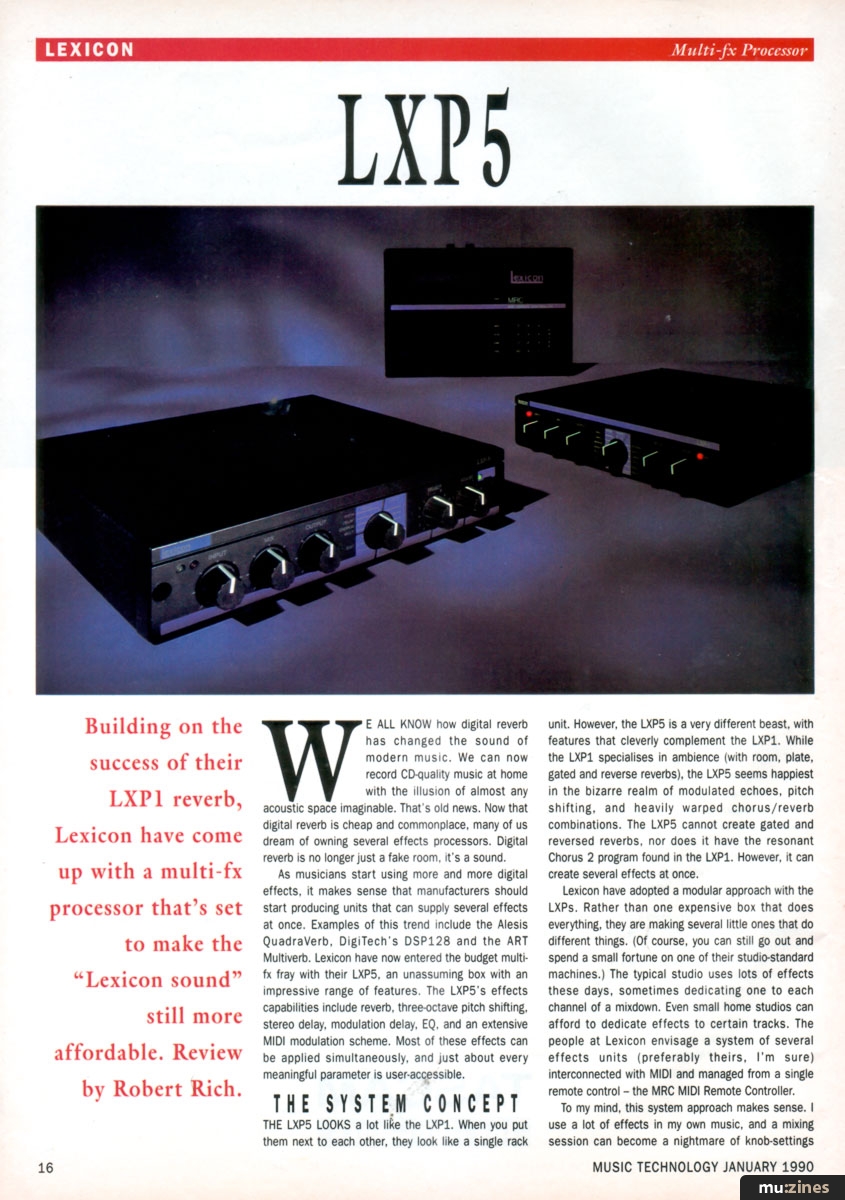
Lexicon LXP5 Multi-fx Processor, review by Robert Rich in Music Technology, January 1990, page 18. Read the article on mu:zines. Held as research material, credited to the magazine and to mu:zines.
In the system
The module is one of the eight stations that the station map settled on in July 2026, beside the Kurzweil K2000, the two lighting stations, M, Trip-A-Tron, the Edirol V4 and a utility station. In ALTERITY it works on the four channels rather than on a single output: the K2000’s four outputs feed the four corner speakers, and the Lexicon units place what is heard across them. In this sense the composition extends into the unit. The placement of what is heard is part of the composing rather than a stage after it, which is how the practice treats placement in quadraphonic sound. In CONDUCTOR the two units are morphed from one preset to the next while the work runs, so the effect becomes a constantly transforming spatial component. The morphing is done by a separate engine that moves one preset to the next and gives each knob its own ramp speed parameter, which is how the capabilities of the units are augmented.
Controls
Every parameter of the module is exposed to the MIDI protocol. Its presets are selected, and its parameters changed, over the same connection that carries the music, so the modules of CONDUCTOR address it as they address the instruments, without a hand on the unit. The manual states that all parameters are accessible by parameter change messages, with continuous controllers, switches and system exclusive data beside them. The practice runs two LXP-5 units together, which is the rig the manual describes when it covers more than one LXP-1 or LXP-5. The editing goes as deep as it does in a synthesiser, with two algorithms determining which parameters a preset offers, one for pitch and delay and one for delay and reverb, and every one of them editable. What the unit works on is time and pitch rather than a waveform: pitch shifting, stereo delays, flanging, modulation and reverb.
Unforeseen
Here the unforeseen situations, sometimes difficult, sometimes unexpectedly interesting, will be described as the project runs. Many of these unforeseen situations have already occurred and have been recorded. They will be added in the time to come.