Part of Temporal Constructs Main Text, which states the research questions, the proposals, the work done and what is still open.
General definition
A digital synthesiser workstation released in December 1991, both synthesiser and computer, built around VAST (Variable Architecture Synthesis Technology), a modular programming environment. It is the first of a series that continued with the K2500 and the K2600. It is a keyboard-based instrument with weighted action and aftertouch, designed for composition and performance.
Relation to the practice
The K2000 runs in ALTERITY, where it is the single sound source, and the doctorate reaches it in detail by mirroring its user interface through SysEx. The presets it shipped with, and the later official sets made for it from outside the company, are a clear case of the embedded authorship the research studies.
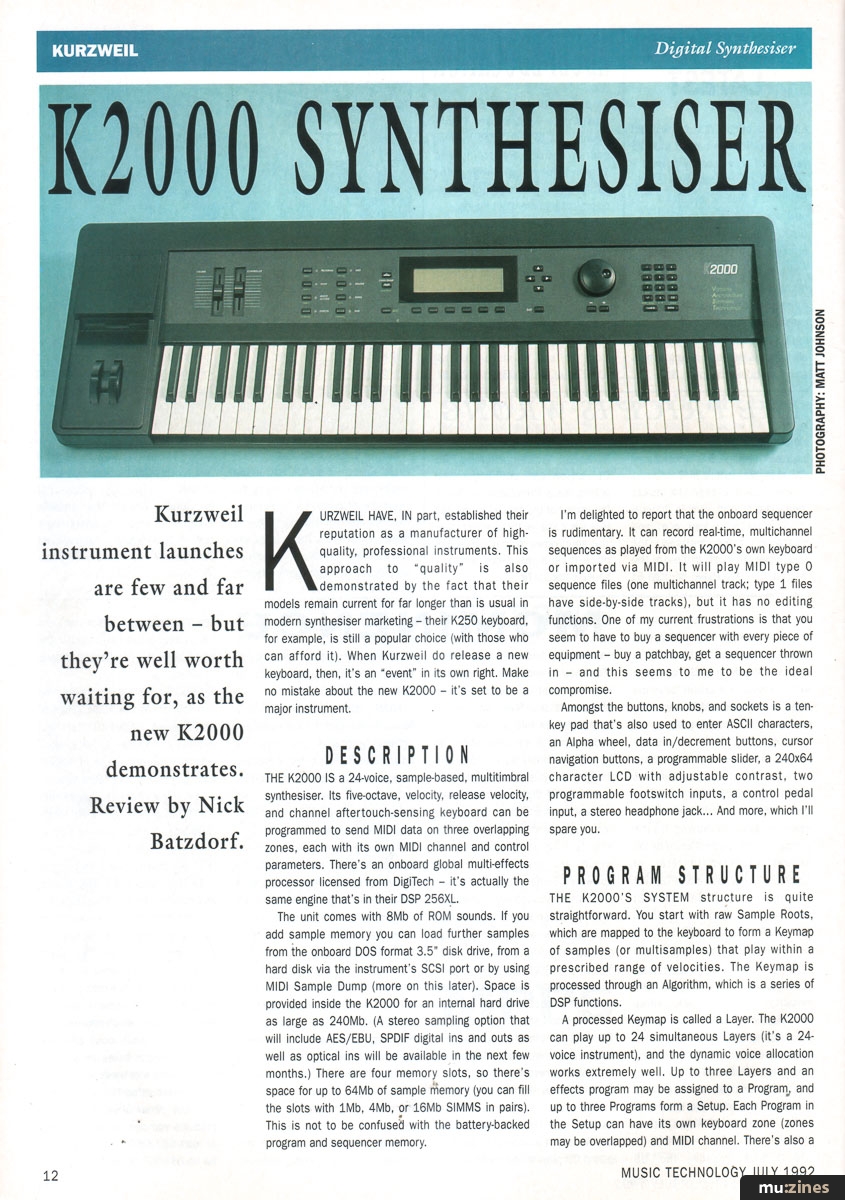
Kurzweil K2000, review by Nick Batzdorf in Music Technology, July 1992, page 14. Read the article on mu:zines. Held as research material, credited to the magazine and to mu:zines.
The machine’s interface is carried over MIDI, which was not common in the period. Its front-panel buttons accept commands and its display returns as data, so the screen can be read and the buttons pressed from outside the machine. The company published the data format as well, so reaching the machine from a program needs no reverse engineering, only a parser for each algorithm of the VAST engine.
An agent works in the symbolic domain, so a machine whose screen arrives as data and whose buttons accept commands can be operated the way a person operates it. The agent reads the display and presses the buttons through the same protocol that carries the notes, and the doctorate’s use of the machine depends on that property. The doctorate mapped its memory in June 2026: up to 64 megabytes of sample memory, and a battery-backed program memory that can be expanded from 120 kilobytes to 760.
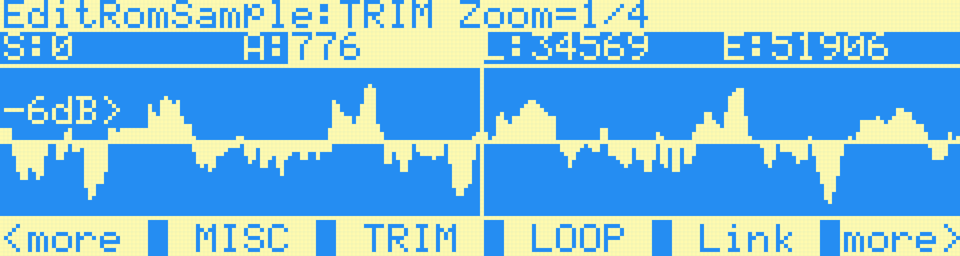
K2000 module
The module that serves it operates the strummer, a device written in Max and Pure Data. Its controller reaches the strummer, and the doctorate composes strums on it inside the conventions of a six-string instrument. An agent composes for this machine this way, without reaching the sound itself.
Design of the machine
The instrument was designed by a team at Kurzweil Music Systems, whose members are named individually in the account by Jennifer Hruska; the company’s founder is not among them. The acronym VAST was coined by Geoff Gee, the principal designer of the patches, and it described the internal structure exactly: a modular synthesiser in digital form in which any parameter can be modulated by any modulator. The modulation system was designed by Ralph Muha. The synthesis engine came from Bob Chidlaw, Hal Chamberlin was responsible for the MIDI handling, and the sample content was made by Jennifer Hruska and Joe Ierardi. John Teele, Rick Cohen, Tim Thompson, Chet Graham and Bill Gardner are named among the other contributors (Hruska, Kurzweil K2000, K2500 and K2600 (2019)). Bob Chidlaw is confirmed by a second source, which lists the physicist among the key team members.
Kurzweil Music Systems was in debt and filed for bankruptcy in 1990, and the company then agreed to sell assets to Young Chang of Korea; Ray Kurzweil received three million dollars and royalties for six years, and he stayed as an adviser to Young Chang until 1994. The engineers stayed together, and a review of 1993 places the research and development team at the Young Chang Research and Development Institute in Waltham, Massachusetts. The K2000 was therefore made by the former Kurzweil Music Systems engineering team under Korean ownership, and Kurzweil’s part in it is that of founder and namesake rather than designer (Kurzweil Technologies on encyclopedia.com). Chris Martirano was the company’s director of product development for twelve years and steered the creation of the K2000, the K2500 and the K2600 (NAMM Oral History, Chris Martirano (2022)).
Where VAST came from
Two reviews of the period give the lineage of the synthesis engine. Craig Anderton, writing in Sound On Sound in March 1992, finds the machine full of modular synthesis thinking: many of the designers had worked with synthesizers in the days of patch cords and had not forgotten what they learned. He traces the non-linear shapers directly to Electronotes, a newsletter for musical engineers, and notes filters that close all the way down to zero, as the old Buchla machines did. VAST is therefore analogue modular thinking carried into digital signal processing, with the engineering press of the 1970s among its sources (Anderton, Killer Kurzweil (Sound On Sound, 1992)). Nick Batzdorf, reviewing the machine for Music Technology in July 1992, records the company’s own framing: VAST offers something like the history of synthesis in one machine, covering subtractive, additive and sample-plus-synthesis approaches.
Hardware of the machine
The custom chips are named after the comic strip Calvin and Hobbes. In the account drawn from the service manual, a chip called Calvin handles the main processor and the PCM ROM and RAM addressing, as well as resampling, and two Hobbes chips are specialised signal processors for sound synthesis; in later units Calvin was replaced by a later chip named Janis. The manual’s self-test messages name them, as in “Connection problem between Calvin and Hobbes 0” (K2000 service manual). The effects engine was not made in house: it is licensed from DigiTech and is the engine of the DSP 256XL. Each voice of the machine can play a separate program, which allows smooth transitions during a live performance, and the reviews single out that feature. It is noted here because it bears on ALTERITY.
A source not used
A history circulating online credits Dave Rossum with the K2000’s hardware design and one Scott Frankfurt with the VAST engine. Rossum co-founded E-mu, and no primary source names Frankfurt; the piece has the marks of machine-written text. It is recorded here as a known unreliable source, because an agent could pick it up in a search.
Presets by Drew Schlesinger
The sounds the machine shipped with in 1991 were the work of the team that designed it, and Jennifer Hruska’s account names Geoff Gee as the principal designer of those patches. Drew Schlesinger’s presets for the K2000 were later additions, issued on official Kurzweil disks, and his sets are the part of the machine’s preset library described here. One such disk is “Best of Analog”, a Kurzweil program diskette with two directories, one of analog sounds and one of new age sounds, released on floppy disk in the 1990s and programmed under the name Andrew Schlesinger (SynthMania, Kurzweil K2000 Best of Analog diskette (n.d.)).
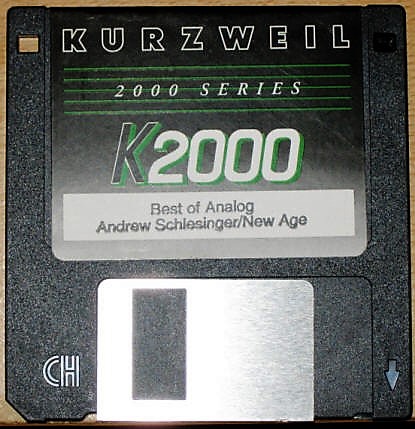
The Kurzweil K2000 “Best of Analog” program diskette, from SynthMania. Held as research material and credited to the site.
He has worked as an independent preset designer since 1984, and his business model placed one designer’s decisions in the instruments of many manufacturers at once. He was not employed by any of them. That arrangement is the case the doctorate studies when it describes a preset shipped with an instrument as embedded authorship.
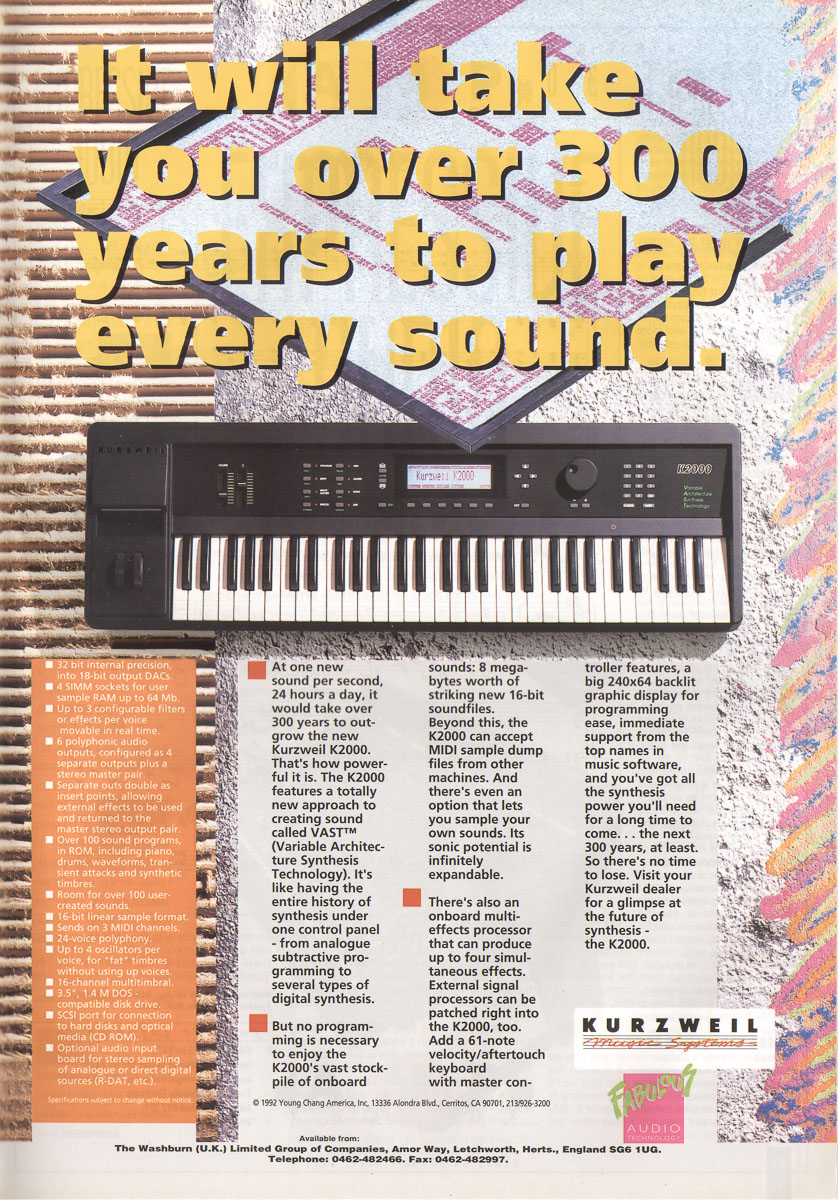
Agent work on presets
The documentation the agents produced from the machine’s presets is research material, and it records what the instrument allows as well as what its presets contain. It is part of the practice’s work on heritage. The knowledge stored in a period instrument survives only if it is written down where it can be read again. The agents use it to learn the environment and its constraints. The work itself is recorded as a discovery of the first year.
Hermes Agent exploring the K2000 presets
Sound of the K2000
The machine combines sampled sound with sound it generates, inside one modular environment, and that combination distinguishes it. The result is a liminal sound, between the recorded and the made, and the work’s narration calls it uncanny. A human and an artificial component sound together in it, which is the aesthetic the machine contributes to ALTERITY. That aesthetic is the same one Ray Kurzweil‘s transhumanist future describes, in which the human and the machine are joined.
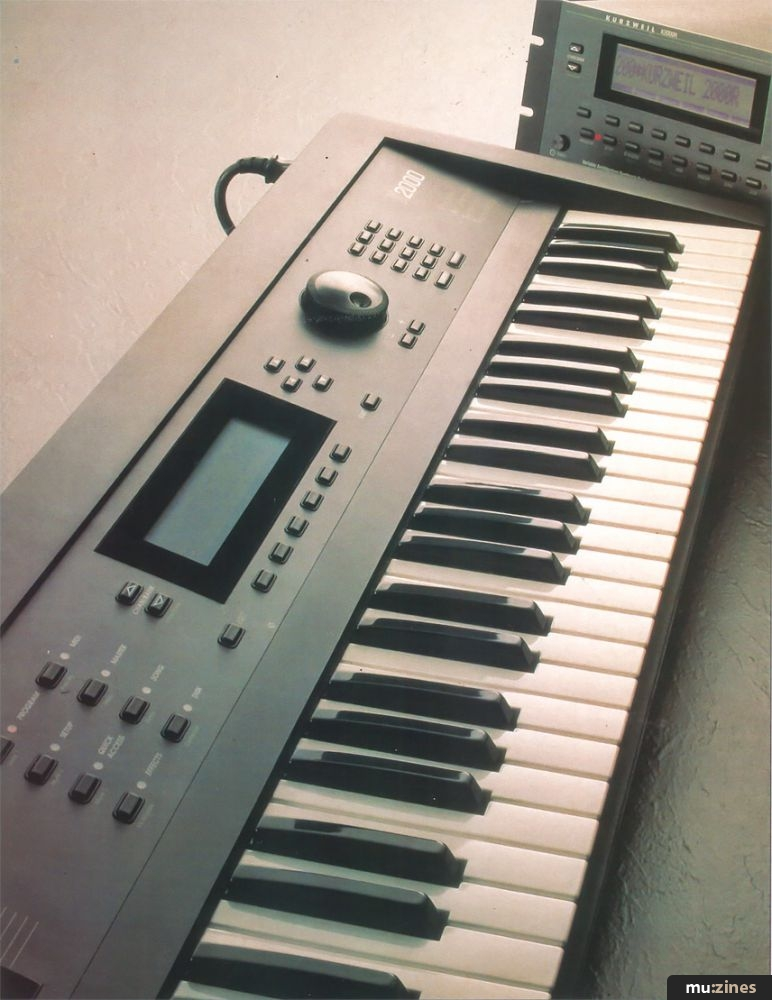
In ALTERITY the K2000 is the system’s single sound source. Its four outputs feed the four corner speakers quadraphonically, so everything else composes, routes and lights while this machine makes the sound. It is also where the work places the end of the period.
The narration speaks about the K2000 in its fifth part, where the transhumanist future of the company’s founder and the machine’s uncanny simulation of acoustic sound are set out.
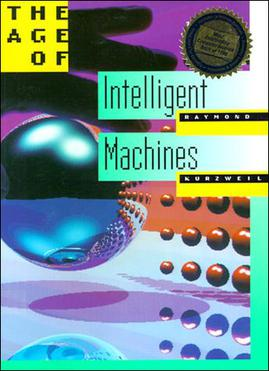
It arrived a year after Ray Kurzweil published The Age of Intelligent Machines, and its model number refers to the millennium that was about to come. The transhumanist future he described was expected by that date. The machine has the functions of a computer and the appearance of an acoustic instrument. It simulates how acoustic sound behaves in the physical world, with an accuracy the work’s narration calls uncanny.
I wrote to Ray Kurzweil, hoping to ask him some questions relating to how he related music and sound creation to Artificial intelligence. Sadly he did not have time when I wrote him, but kindly sent his latest book over “The Singularity Is Nearer” signed “Hi Jacco, Thanks for your contribution to the singularity, Ray Kurzweil”.
artist statement
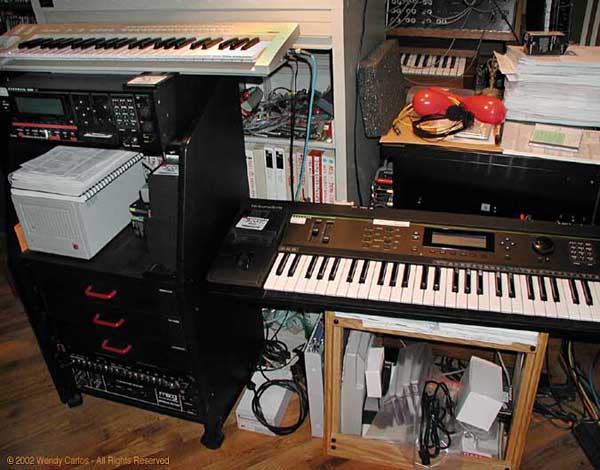
The K2000 in the electronic music studio of pioneer Wendy Carlos
Some recordings made with the K2000
Unforeseen
Here the unforeseen situations, sometimes difficult, sometimes unexpectedly interesting, will be described as the project runs. Many of these unforeseen situations have already occurred and have been recorded but are not yet part of the archive. They will be added in the time to come.