Part of Temporal Constructs Appendix, which contains details behind the research: dates, quotations, descriptions of instruments, and sources.
General definition
Two MIDI processors of 1991 from the Perf/X line, which their maker called MIDI Performance Effects. Neither has any sound of its own. Both read MIDI from a keyboard and transform it: the Strummer turns chords into guitar-voiced ones and strums them, and the Drummer supplies drum patterns that follow the player.
Relation to the practice
They are the period precedent for the practice’s own example device, which they in part inspired. They are also the hardware case of what this archive calls a rule-based instrument. Their transformation is governed by rules about the instrument being imitated. They mark where the line falls for the doctorate, which reserves intelligent instrument for software and counts these as hardware, the form the idea took in 1991.
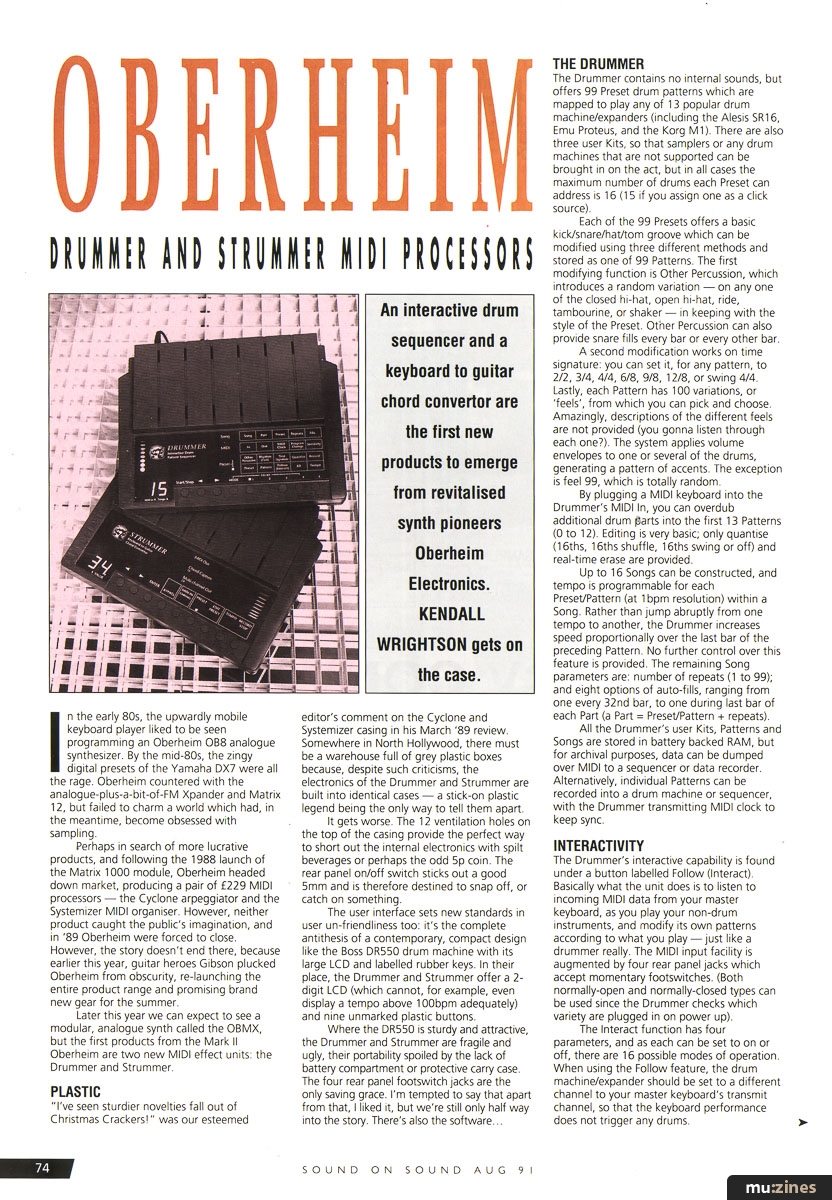
Oberheim Drummer and Strummer, review in Sound On Sound, August 1991, page 76. Read the article on mu:zines. Held as research material, credited to the magazine and to mu:zines.
Function of the Strummer
It reads the notes and velocities played on a keyboard and sends out the notes a guitarist would play. A chord is re-voiced to one that a guitar can finger. The voicing depends on the range of a guitar, the number of notes played and the position of the chord. The strum is produced by averaging the velocities of the notes and separating them in time in ascending pitch order. Strum rate and direction are among its parameters.
It also converts chords into guitar chord voicings with simulated strumming. It echoes and arpeggiates the MIDI it receives. It notes short riffs and plays them back from a trigger note. It has 96 presets, 64 fixed at the factory and 32 for the player’s own use. It supports system exclusive for storage and remote editing.
Function of the Drummer
It has no internal sounds. It has 99 patterns, mapped to thirteen drum machines of the day. Three user kits cover anything those machines do not support. Its interactive mode listens to the incoming MIDI as the player plays other parts. It modifies its own patterns and adds fills in response, which makes it more than a pattern player.
Perf/X series
The Perf/X series was the maker’s name for its MIDI Performance Effects. The two modules came after the earlier three of that line: the Cyclone, the Systemizer and the Navigator. The reviews of 1991 complain about the case, a plastic box shared by both units. They also complain about the two-digit display and the nine unlabelled buttons, and they praise what the software did. That software was absorbed, and the features these modules introduced reappeared inside the instruments and programs that followed them.
Elements from the pair
Two things in the practice come from them. The first is the form, a device played by transforming MIDI. A person or an agent works in names and numbers while another machine makes the sound. The second is the condition for the transformation to be legible.
That condition is that the device imitates an instrument the player already knows. A guitar’s range and chord shapes give the space its meaning. The Oberheim pair were built for a person at a keyboard, and the example device was built for an agent to compose inside, which is where the two differ.
Unforeseen
Here the unforeseen situations, sometimes difficult, sometimes unexpectedly interesting, will be described as the project runs. Many of these unforeseen situations have already occurred and have been recorded. They will be added in the time to come.