Part of Temporal Constructs Main Text, which states the research questions, the proposals, the work done and what is still open.
General definition
The strummer is a device of the system, written in Max and Pure Data. The module serving the synthesiser operates it through its controller in order to compose strums. It is also the worked example of what a device is, and of a model creative inside a fully legible space.
Relation to the practice
The strummer lets agents compose inside the conventions of a six-string instrument through its controller. Its value is that it makes a device’s structure visible in full. A function is something built into hardware or into a Max or Pure Data patch that a single control change message can reach.
The strummer exposes twenty-four such functions, each taking a value from nothing to one hundred and twenty-seven, so the space it describes is finite and entirely readable, and it cannot be searched by hand, which is the condition an agent works in.
Origin of the device
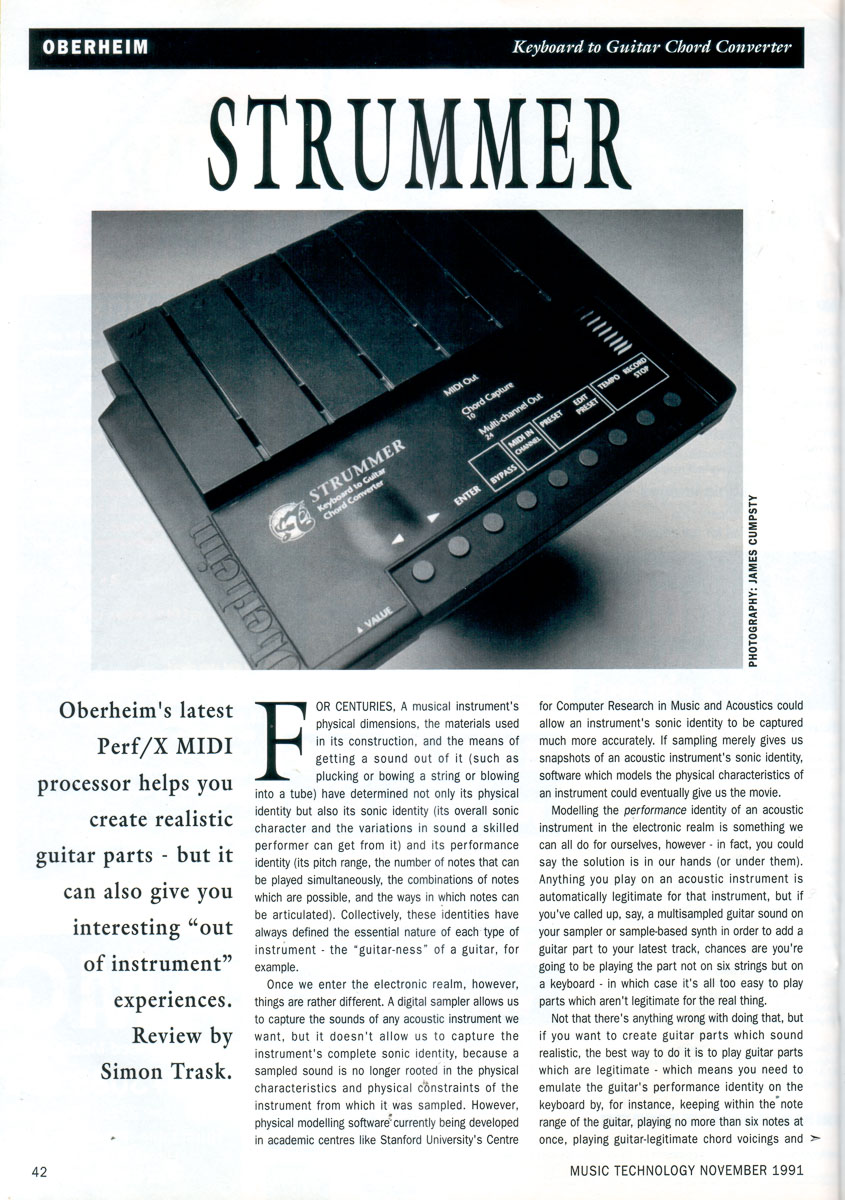
The strummer took part of its inspiration from the Oberheim Strummer and Drummer of 1991. Those two MIDI processors had no sounds of their own and transformed what a keyboard sent them. The strummer took their form and their condition: a device is played by transforming MIDI, and its space is legible because it imitates an instrument the player already knows. The Oberheim pair were built for a person at a keyboard, and the strummer was built for an agent to compose inside.
An agent wrote the device and its explanation in October 2026, during the work of explaining the system and on the artist’s direction. The strummer therefore belongs with the interfaces the agents built.
Functions and parameters
Six strings carry four functions each, twenty-four in all. In the wiki article the four are the open string note, taking MIDI notes 28 to 76, and the fret number, 0 to 24, followed by the velocity and the time delay, the delay taking 0 to 250 milliseconds. In the compact overview of the same material the four are labelled level, pitch, timing and decay, and addressed as control changes 1 to 24. Those labels are marked as placeholders. The two descriptions are unreconciled, and one set must be settled on before either is published.
Twenty-four functions, each taking one of one hundred and twenty-eight values, give about 3.7 times ten to the fiftieth distinct settings. That space is finite, fully legible, and far too large to search by hand. An agent working here generates no sound at all. What it produces is a choice of twenty-four numbers, and the musical decision lies in that choice. The limits of the functions bound it. A fret cannot exceed twenty-four and a delay cannot exceed two hundred and fifty milliseconds.
Familiar conventions
The device rests on an assumption that the practice maintains and tests: an agent can compose when the limits it works inside follow conventions already present in a model’s training data. A six-string guitar serves as the case here. Its space is enormous and its meanings are familiar, so a model choosing numbers chooses inside a form it has met before. On that assumption the strummer is the practice’s clearest small example of a rule-based instrument built for an agent.
Command path and sound
The order runs from the system to the instrument, and the module comes first, then the device. An agent does everything in CUE, the command language, which operates the controller and where an author writes the snapshots and presets for a device and its hardware. CUE cannot reach a device directly, so the module’s controller holds the mapping for the strummer, and the device then connects to the hardware. The path is CUE, the controller, the device and the hardware, with the module as the thing the controller is part of.
One snapshot of the strummer is one strum. Strums are placed as events on a timeline track, which is mapped to the strummer operated by module 01, the module that serves the synthesiser. Clicking an event runs the chain the system uses everywhere: the timeline, the snapshot memory, the controller, the device, the hardware. A person can turn the knobs and store the snapshot to overwrite an event, and empty positions can take new strums composed by a person or by an agent. The sound is plucked-string synthesis in the browser, so nothing heard in it was played.
Composition of 5 September
A composition that Hermes Agent made on the strummer on 5 September 2026 is recorded here. The agent was asked for a piece with a liminal, dreamy atmosphere, played on the strummer as though it were a string instrument. It worked in the sketchpad of the module serving the synthesiser, the working space that keeps, loops and varies recalls before material is stored as a snapshot, and what it made there is a sequence of strums. The strums are played through the device into the synthesiser, which is the sound source of the system.
We can hear in this composition that the agent understood what it could achieve by giving each string a unique presence. The result is surprisingly human-like, though the gesture of each strum has been approached compositionally.
Unforeseen
Here the unforeseen situations, sometimes difficult, sometimes unexpectedly interesting, will be described as the project runs. Many of these unforeseen situations have already occurred and have been recorded. They will be added in the time to come.