Part of Temporal Constructs Appendix, which contains details behind the research: dates, quotations, descriptions of instruments, and sources.
General definition
A protocol is an agreed specification for how devices exchange data. In music technology the central protocol is MIDI (1983). MIDI lets instruments and computers communicate through small messages on sixteen channels.
Relation to the practice
Akrich (1992) describes how a standard carries its designers’ intentions. Star and Griesemer (1989) describe how one lets work travel between parties. MIDI, agreed in 1983 and still carrying its messages, is the case both of them use.
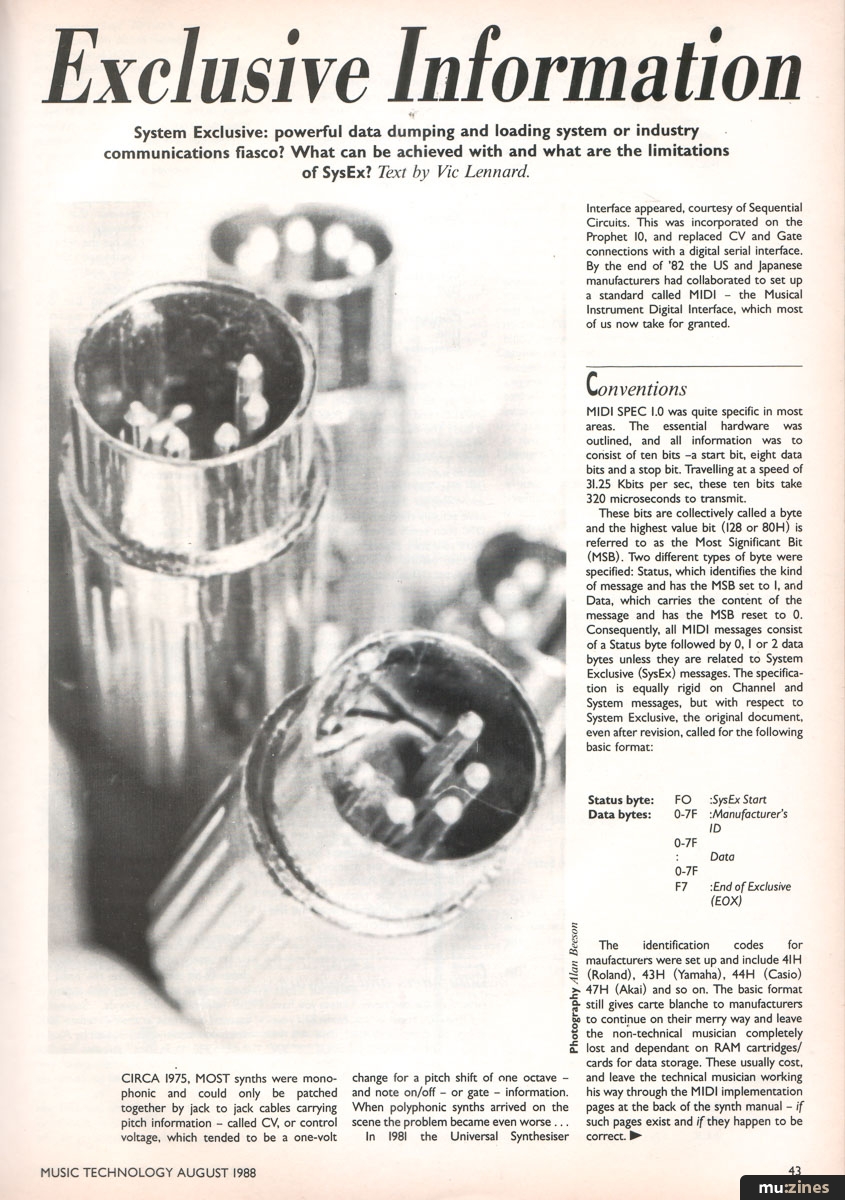
Exclusive Information, a feature on system exclusive messages, Music Technology, August 1988, page 45. Read the article on mu:zines. Held as research material, credited to the magazine and to mu:zines.
The doctorate describes protocols and their specific implementations as a layer of human design decisions. Their designers decided which parameters could be reached and which could not. That permanence makes most of what is built upon a protocol reliable. It limits what can be mapped. MIDI and its system exclusive messages carry control of sound, and DMX handles control of light. The sixteen MIDI channels also serve as a model for the structure of CONDUCTOR. MIDI hardware and software helped to instruct many of the design choices during the development of custom AI-agent frameworks.
The sixteen channels of MIDI are set against the sixteen modules of CONDUCTOR, one channel to one module. The protocol’s ceiling fixes their number and therefore becomes a deliberate constraint.
flowchart LR
  subgraph MODS["CONDUCTOR, sixteen modules, one to a channel"]
    M1["Module 1<br/>on channel 1"]
    M2["Module 2<br/>on channel 2"]
    M3["Module 3<br/>on channel 3"]
    M4["Module 4<br/>on channel 4"]
    M5["Module 5<br/>on channel 5"]
    M6["Module 6<br/>on channel 6"]
    M7["Module 7<br/>on channel 7"]
    M8["Module 8<br/>on channel 8"]
    M9["Module 9<br/>on channel 9"]
    M10["Module 10<br/>on channel 10"]
    M11["Module 11<br/>on channel 11"]
    M12["Module 12<br/>on channel 12"]
    M13["Module 13<br/>on channel 13"]
    M14["Module 14<br/>on channel 14"]
    M15["Module 15<br/>on channel 15"]
    M16["Module 16<br/>on channel 16"]
  end
  MIDI["MIDI, 1983<br/>sixteen channels"]
  MIDI --> M1
  MIDI --> M2
  MIDI --> M3
  MIDI --> M4
  MIDI --> M5
  MIDI --> M6
  MIDI --> M7
  MIDI --> M8
  MIDI --> M9
  MIDI --> M10
  MIDI --> M11
  MIDI --> M12
  MIDI --> M13
  MIDI --> M14
  MIDI --> M15
  MIDI --> M16
Added as the research runs.
Unforeseen
Here the unforeseen situations, sometimes difficult, sometimes unexpectedly interesting, will be described as the project runs. Many of these unforeseen situations have already occurred and have been recorded. They will be added in the time to come.